Image by Rosalind Atkins. Please contact me if you are unhappy with its use.
(Soon to be replaced by my own linocut efforts…)

Sunday, August 22, 2010

11. The Seven oaks of Sevenoaks


Tricky one this. Although at various times there have indeed been seven oaks planted in Sevenoaks, all of those referred to in records seem to be predated by the town. As recently as 1902, seven oaks were planted around the Vine cricket ground (which dates back to 1773 and is the first place in England where a game of cricket was played with three stumps instead of two). These seem to be replacements – contemporary paintings and photography from 1900 depict 'The Seven Oaks' at the same location. After the Great Storm of 1987, all but one of the 1902 trees were uprooted. The six felled trees were replaced, but after vandalism and more replanting, there are now – rather confusingly – nine oaks on the site.

Local lore states that the town was named after a Saxon chapel called Seouenaca in the grounds of Knole Park. It is possible that this name is in fact derived from the fact that seven oaks stood near the chapel in about 800 AD. (The Middle English for seven is recorded both as 'seofan' and 'seouen'.) However, it wasn't until the 13th Century that a market town is recorded as existing around the Knole estate.

And then there's Sir William Sennoke or Sevenoke, who became Lord Mayor of London in 1418 and whose life followed almost as many twists and turns as the man who replaced him as Lord Mayor the following year – Dick Whittington.
Legend has it he was discovered by Sir William de Romschedde as an orphan under seven oaks near the small hamlet of Riverhill in Kent. After serving as an apprentice grocer in London, he became first Sheriff and then Lord Mayor of London, and amassed considerable personal wealth, which he used to fund 20 almshouses as well as a free school in 1432 (originally Queen Elizabeth's Grammar School, now Sevenoaks School) "at Seven-oaks". Although the school is now far from longer free, Sir William's charity still lives on in the form of scholarships.

So, to recap: there are plenty of oaks in Sevenoaks. At various times since 800 AD there have been seven in a group, varying in location from Knole Park, Riverhill and The Vine. Which ones the town are named after is uncertain – but it's unlikely, sadly, that any are still standing.

Sunday, August 15, 2010

10. The St Lawrence Lime


There are many reasons to love cricket. For start, there are few other games where you can watch a single match for five days solid and still celebrate the fact there's no result. This is a sport that inspires batsmen to selflessly walk before being given out, while accepting mental disintegration as a legitimate tactic. But rather than going into all the game's many and various idiosyncrasies, let's just concentrate on one: the St Lawrence Lime.

Faced with a tree growing in the middle of a pitch, any other sport would do one of two things: move the pitch, or chop the tree down. But cricketers think differently. So when Kent County Cricket Club's home ground was founded in Canterbury in 1847 (then called Beverley, but latterly changed to the St Lawrence Ground), it was built around a local lime tree.

Obviously, having a tree the wrong side of the boundary can pose a few practical problems, but Kent's players soon settled on the rule that a shot striking any part of the tree was worth four runs. A bonus if the ball trickled into the tree's substantial undergrowth, but a bit annoying if its 120ft height obstructed an otherwise clear six. (The only player since the war to successfully score a six over the tree was Carl Hooper of Kent and the West Indies, in 1992.)

Sadly, in January 2005, high winds finally brought the tree down. However, the club had already been working on a successor, since the St Lawrence Lime had been found to be suffering from heartwood fungus. In March 2005, the fledgling tree was moved within the boundary to take up its rightful place in cricketing folklore.

Sunday, July 11, 2010

9. The Leith Hall Dule


Amongst the 260 acres which make up the grounds of Leith Hall, Aberdeenshire, stands an impressive sycamore, 116cm in diameter, known to locals as the Dule Tree. The word 'Dule' derives from the Gaelic for 'grief'; which will give you some indication as to the tree's former sinister purpose.

Dule trees were used for execution by hanging, and also often as a 'gibbet' for displaying the corpse of the executed man as an example to others. Sycamores were commonly used as dules due to the strength of their branches. The Leith Hall 'dule' is believed to date from around 1650, when the Leith-Hay family built their stately pile on the site of the medieval Peill Castle. Although the sycamore was probably planted at the time the new hall was built, there was likely to have been a gallows tree at the castle previously. Baronies in Scotland retained the ancient tradition of the 'pit and gallows' right up until The Heritable Jurisdictions Act of 1746, which sought to bring the vagaries of local justice under official government legislature.

Several ghosts are said to haunt the site, including that of Laird John Leith III, who died after being shot in the forehead in a drunken duel on Christmas Day, 1763. Numerous guests have reported seeing his apparition, with a bandaged head, while staying at Leith Hall - including several patients who were treated there during the Great War, when the building was used as a temporary hospital.

Monday, May 31, 2010

8. The Bolan Tree


Two centuries later, and another memorial to an English legend. Only this time the tree in question wasn't planted in honour of the dead hero, but was the direct cause of his death.
An unprepossessing sycamore on Queens Ride, Barnes in London marks the spot where T-Rex singer/songwriter Marc Bolan died on 16th September 1977. Bolan was returning from a night out at Mortons, a club in Mayfair, with his girlfriend Gloria Jones (singer of the original Tainted Love). They were less than a mile from Bolan's East Sheen home when Jones lost control of her Mini on a hump-back bridge and crashed into the tree.
Bolan, who wasn't wearing a seatbelt, was killed instantly.

Fans quickly turned the tree into an unofficial shrine to Bolan, and in 2007 (the 30th anniversary of his death), this was formalised by the English Tourist Board in 'England Rocks', their 'New Guide of Sites of Rock'n'Roll Importance'. Memorial plaques and a bronze bust of Bolan also feature at the site. The tree itself has been tended by the T-Rex Action Group since 1999, when it was in danger of falling down.

Several conspiracy theories suggest Bolan had a typically poetic premonition of his death:
• In the song 'Celebrate Summer' he sings "Summer is heaven in 77".
• In the song 'Solid Gold Easy Action', he sings "Easy as picking foxes from a tree". The number plate on Jones' Mini was FOX 661L.
• In the same song is the line "Woman from the East with her headlights shining eased my pain and stopped my crying". As they were driving from central to South West London, they were technically travelling from the East; plus their home was in East Sheen. Jones herself, however, was from Cincinnati, which is the West however you look at it.

I don't know if it helps to suggestthere's something mystical about a man dying in a car crash. But if you want to pay your respects to an undeniable talent, track the tree down (opposite Gypsy Lane) and leave your own floral tribute.

Sunday, May 2, 2010

7. The Trafalgar Woods and the Nile Clumps


Achille. Africa. Agamemnon. Ajax. Belleisle. Bellerophon. Britannia. Colossus. Conqueror. Defence. Defiance. Dreadnought. Entreprenante. Euryalus. Leviathan. Mars. Minotaur. Naiad. Neptune. Orion. Phoebe. Pickle. Polyphemus. Prince. Revenge. Royal Sovereign. Sirious. Spartiate. Swiftsure. Temeraire. Thunderer. Tonnant. Victory.

The final name in that list should be the giveaway even if you weren't paying attention in history class: they're the names of the 27 Ships-of-the-Line and six support ships of Nelson's fleet in the Battle of Trafalgar. It also happens to be the name of 33 woods planted across Great Britain and Northern Ireland by the Woodland Trust as part of its Trafalgar Woods project. Started in 2005 to mark the bicentennial of Nelson's famous victory over the Spanish and French fleets, the project has seen over 250,000 new trees planted, celebrating the link between British timber and its maritime history.

It is estimated that 6,000 trees went into the building of HMS Victory, 90% of which were oak, with pine, fir, elm and Lignum Vitae used in finishings. Construction began in 1759 but, thanks in part to the end of the Seven Years War, Victory's frame was uniquely left to season for three years (rather than the standard few months), which many believe was a key factor in the ship's longevity.

The Trafalgar Woods aren't the first time that trees have been planted to commemorate a Nelson victory: the Nile Clumps on Salisbury Plain mark his 1798 defeat of the French in the Battle of the Nile. Planted by Charles Douglas, 6th Marquess of Queensbury on his own estate near Stonehenge, the beech trees were built in clumps representing the positions of the French and British ships in the battle. Of an original 26 clumps, 17 still remain.

The trees are sometimes falsely referred to as the Trafalgar Clumps, although it is obvious that they do not refer to the position of ships at Trafalgar. Nelson's unorthodox tactic at Trafalgar was to puncture the Franco-Spanish line by driving his fleet perpendicularly through the enemy formation at two points, rather than coming alongside it in single file, as was the norm. So the trees on Salisbury Plain would more closely resemble a 'hash' symbol than two parallel lines had they been planted in honour of the later battle.

Sunday, April 4, 2010

6. The Ankerwyke Yew


You might notice a bit of a pattern emerging with yew trees. Because of their potential to live to a great age (in fact greater than any other plant in Europe), it's almost inevitable that they become intertwined with local legends.
Even with the difficulty in accurately aging them (since the boughs of ancient yews are often hollow, making a ring count impossible), there are usually contemporary reports that can help us to make an educated guess. The fact that yews often predate any nearby dwelling (and can often be the reason any such dwelling is sited there) means they are naturally bound to local history and folklore.

Having established all that, when I tell you that the Ankerwyke Yew sits on an island in the Thames opposite Runnymede, you'll know what's coming next: there are rumours that King John signed the Magna Carta under its boughs. As the one landmark that has survived since 1215, it's inevitable that people try and tie the two together. And who's to say King John didn't admire the grand old tree - which could well have been 1,000 years old even then - as he dipped his seal in the wax on completion of England's first constitution?

But it doesn't end there. We're also told that King Henry VIII courted Anne Boleyn beneath the tree's branches. If that sounds a little more far-fetched, surely it's not unreasonable to think that the young Henry would find it a romantic spot, fitting for the King of England to impress his future queen?

Monday, March 22, 2010

5. The Tolpuddle Martyrs' Tree


Britain's trade unions are typically associated with its industrialised cities, but the roots of an organised labour movement can be traced to rural workers, squeezed out by the Inclosure Acts of the late 18th and early 19th Centuries. These acts essentially handed areas of common land to the rich, denying members of the public their traditional right to graze their livestock there and re-establishing a feudalist system of land ownership.

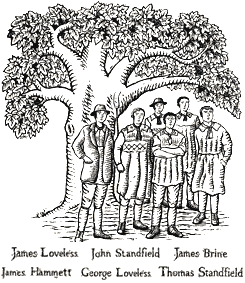
In 1834, The Friendly Society of Agricultural Labourers was formed by six men from the small Dorset village of Tolpuddle near Dorchester, lead by the methodist preacher George Loveless. They met beside a sycamore tree in the village square and drew up plans "to preserve ourselves, our wives and our children from utter degradation and starvation". Despite the average family expenditure of the time being over 13 shillings, the men were seeing their wages reduced to below seven shillings. The group avowed they would refuse to work for less than 10 shillings a day.

At the time, the government had been rocked by a succession of Swing Riots, in which agricultural labourers across the south of England had destroyed farm machinery and maimed cattle in protest against threats to their livelihood. When local landowner James Frampton cited the obscure 1797 Mutiny Act in an official complaint about the group to the Whig government, the opportunity presented itself to make an example of them. The six: Loveless, his brother James, his brother-in-law Thomas Standfield, Thomas's son John, James Brine and James Hammett, were all transported to Australia.

Within three years, all had been pardoned and released. On his return, Loveless wrote an account of their case, The Victims of Whiggery, while James Loveless, Thomas Standfield and Brine co-wrote The Horrors of Transportation. Both publications are now seen as essential texts in the birth of trade unionism, and the village green and tree where the men met is conserved by the National Trust for its historical significance.